 |
celebrating three hundred years of music by women |
Vicomtesse Marie Clémence de Grandval (1830-1907)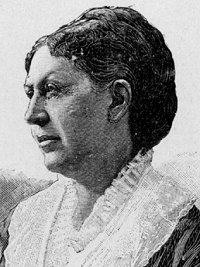 Marie Grandval was the most important French woman composer of the second-half of the 19th century. Her teachers included Friedrich Flotow (1812-1883), Fre´de´ric Chopin (1820-1849), and for two years with Camile Saint-Sa&e235;ns (1835-1921). She composed extensively, including ten operas and many choral and orchestral works, sometimes published under various pen names (entertainingly - Valgrand). As a vegetarian and a spiritualist, she was considered eccentric; but this did not disturb a highly successful performing career. In 1877 she made her professional debut as a pianist in Charles-Marie Widor's (1844-1937) Trio at the Salle Pleyel in Paris. She was not interested in the French musical mainstream, or the Conservatoire; so she was not influenced by their trends and manners, and remained true to herself.
She also wrote three symphonies, and several pieces of chamber music. IMSLP has thirty three of her works IMSLP. Her first opera Le sou de Lise was given its première at the Bouffes-Parisiens Paris in 1859. The most important of her operas was the five act Mazeppa, which premièred in Bordeaux in 1892. The critic Fernard Bourgeat (1851-1932) commented “Lending itself very well to the stage, this work, admirably rendered, and at once elegant, intense, masterful and transparent, has received such acclaim in Bordeaux that one cannot doubt that Paris, too, will shortly be hearing it.” It can be seen on Youtube. Her stature as a respected composer is clear from the many favourable contemporary reviews of her works. François-Joseph Fétis (1784-1871) remarked on the vigour with which she approached a wide range of musical genres, 'giving proof in each that if she was not a genius, she was at least genuinely talented'. A copy of her Messe in the Library of Congress, Washington is inscribed to Georges Bizet (1838-1875). The Bibliotèque nationale de France lists 92 items from 1851 to 1894: BnF. Her friends were well-known composers and other musicians of the time, many of whom were dedicatees of her works, including Charles Gounod (1818-1893) and Saint-Saëns. In 1880 she won the inaugural Concours Rossini with her oratorio La fille de Jaïre. In 1890 the Académie des Beaux Arts awarded her the Prix Chartier. Among others, she was friends with Georges Gillet (1854-1920) and he inspired several oboe and cor anglais works (see below). In the 1870s she contributed substantially to the Société Nationale de Musique and was the most played composer in the Society. Click on these works for more details below: Here's part of the Romance, by my Ensemble Grandval, from the collection of Romantic women in the Ambache Recordings Romantic CD, including her Deux Pieces. For a listing of Grandval's works visit Compositions. Back to Contents Offertoire from the Messe. 1867. Andantino maestoso. 2 fl, 2 ob, 2 cl, bs cl, 4 hns, 2 tpt,3 tbn, timps, hp, strings. 8 mins The Messe has seven sections, and the Offertoire is placed between the Credo and the Sanctus. It is a gravely processional orchestral movement, built on two broad, expressive melodies; the first is announced by solo bass clarinet, and much later presented in canonic imitation by violins and horns, while the second, marked très doux is heard on violins against shimmering harp arpeggios and leads to a beautiful enharmonic modulation characteristic of Grandval's rich chromatic style. While the heightened atmosphere is remeniscent of Fauré's Requiem, it's worth noting that she wrote her Messe 10 years before his Requiem. The Ambache Orchestra gave the UK première in 1997. Back to Contents Deux Pieces pour Hautbois, Violoncelle et Piano. 1884 1. Romance: Andantino, G major. 2. Gavotte: Allegro non troppo. 7 mins The elegant Romance has an elegiac atmosphere, with a dramatic middle section. Grandval has a gorgeous sense of harmony, and the whole is tinged with a sensuous melancholy. The Gavotte trips along in lighter manner, with a more flowing central section. See above for the Ambache Ensemble's recording. Published by June Emerson Wind Music (No 371). Back to Contents Deuxième Grand Trio pour Piano, Violon et Violoncelle. 1853 1. Allegro, E flat. 2. Vivace, G major. 3. Tempo di Minuetto, G minor. 4. Allegro animato, E flat. 21 mins Grandval studied the piano with Chopin, and was a marvellous pianist, as indicated by the sizeable piano piano in this Trio. There is also great textural variety, with the strings taking lyrical moments. The Scherzo second movement is playful, while the third is more melodic. The finale is light and humerous, with a jaunty second theme. There is a brilliant coda, which drives excitedly towards the end. Published by Hildegard.com (No 494-02619). Back to Contents Prelude et Valse Lent pour Cor Anglais or Clarinette et Piano. 1885 1. Prelude: Andante espressivo, A flat. 2 Vales Lent: Allegro quasi Andantino, E flat. 8 mins More haunting harmonies, and romantic dancing. Writings Clémence de Grandval in the French artistic culture of the XIX century Ling Du, 2023. The image of Ivan Mazeppa in opera works of the 19th century, Du Ling. Portrait de Cécile Chaminade Cécile Tardif, 1993. Sainte Agnès Heugel 1892, 2-part sacred drama. How to play my best known pieces The Étude Magazine, 1908, Chaminade. Cécile Chaminade, a Composer at Work, Karen Jee-Hae McCann, MA 1999, University of British Columbia. Information Bibliotèque national de France. Recordings Works for Oboe, Lajos Lencsés, Hänssler 98295; review in MusicWeb International. Songs by Chaminade Albany, Soo-ah Park. French Songs, Chère Nuit Chandos, Louise Alder. Saisons d'amour, 22 songs, MDG, Katharina Kammerloher. Piano Works Chandos, Eric Parkin. A Room of her own Chandos, Neave Trio. French Flute Concertos BIS, Manuela Wiesla. Concertstück, Piano & orchestra, Op 40, Danny Driver, BBC Scottish S O. Stephen Hough's French Album, Hyperion. Scores Piccolino, d'après V. Sardou Open Library, 1868. La Fille de Jaïre; Collin. Hildegard.com Sonata; Trio; Songs. MusicaNeo Musik Fabrik. Schott Music Sérénade aux Étoiles, and others. Cécile Chaminade Piano Music Dover, 2013. Piano Trio No 2 Edition Silvertrust. Flute Concertino, Op 107 Schott Music. Nouvelles Mélodies Heugel, 1857. Kalmus.com includes Concertstück, Op 40. Deux Pièces 1885, clarinet & piano. Sonata in G minor Carl Fischer. Other publishers, including June Emerson Wind Music.
|